

Two builders can quote completely different structural systems for the same sloping block — one proposing a cut-and-fill concrete slab, another an engineered steel floor system suspended above the slope. For someone who is not a structural engineer, choosing between them can feel impossible. Both options are legitimate. Both are used on Queensland hinterland sites. However, the right choice depends heavily on cross-fall gradient, soil classification, and site access — and getting it wrong is expensive.
This comparison explains how each foundation system works, what the real cost drivers are on a steep site, and which site conditions favour each approach. The goal is to equip you for an informed conversation with your engineer before committing to a structural system.
Why Sloping Blocks Need a Different Structural Approach
A flat site allows a concrete slab poured directly onto prepared, compacted ground. A sloping site introduces a different problem entirely. Where the cross-fall across a building footprint exceeds 1 metre, the challenge is straightforward: the ground is not level, but the building must be. Achieving that level platform means either reshaping the ground to be flat — cut and fill — or building a structural floor that bridges the slope from beneath.
Each approach has different site impacts, cost drivers, and long-term consequences. The steel floor system vs concrete slab sloping block decision is therefore not a simple cost comparison. It involves earthworks volume, soil type, site access, and the degree of slope, all interacting — and getting it wrong can add $30,000–$100,000 to a project before the frame goes up.
The Sunshine Coast hinterland and surrounding rural areas are particularly slope-heavy. The basalt and sandstone geology of the Great Dividing Range foothills regularly produces cross-falls of 2–5 metres across a typical building footprint on acreage lots. For sloping block solutions across Queensland, understanding the structural approach before design begins is essential — the foundation system affects the floor plan, the approval documents, and the total project cost.
How Concrete Slabs Work on Sloping Sites
On a gently sloping site — cross-fall under 1 metre — a stepped or waffle-pod concrete slab is a reasonable and often cost-effective foundation. The structural engineer designs the slab to follow the natural grade in steps, minimising earthworks while still achieving a level finished floor. On flat and near-flat sites, concrete is reliable, well-understood, and competitive on cost.
On steeper sites, however, the picture changes significantly. A conventional concrete slab on a steep block requires cut and fill: excavating the high side of the block and using that material to build up the low side to create a level platform. This process requires careful engineering to avoid destabilising the slope, and it typically involves retaining walls on the cut side.
Retaining walls on Sunshine Coast and Gympie hinterland sites carry their own engineering requirements. Reactive clay soils and high seasonal rainfall combine to make retaining structures expensive — engineered retaining walls in this environment can cost $20,000–$80,000 or more, depending on wall height, soil type, and drainage requirements. Furthermore, earthworks alter the natural drainage patterns of the site, which can trigger additional water management conditions in the building approval process.
On a gentle slope with good site access, concrete remains reliable and cost-effective. On a medium to steep slope, however, the total earthworks cost makes a concrete slab foundation significantly more expensive than the slab price alone suggests.
How Engineered Steel Floor Systems Handle the Same Slope
An engineered steel floor system approaches the problem differently. Rather than reshaping the site to suit the floor, the structural steel frame is designed to span across the slope. Posts or columns are set into engineered footings at varying depths, and the floor frame is constructed at the correct finished floor level regardless of the gradient beneath it.
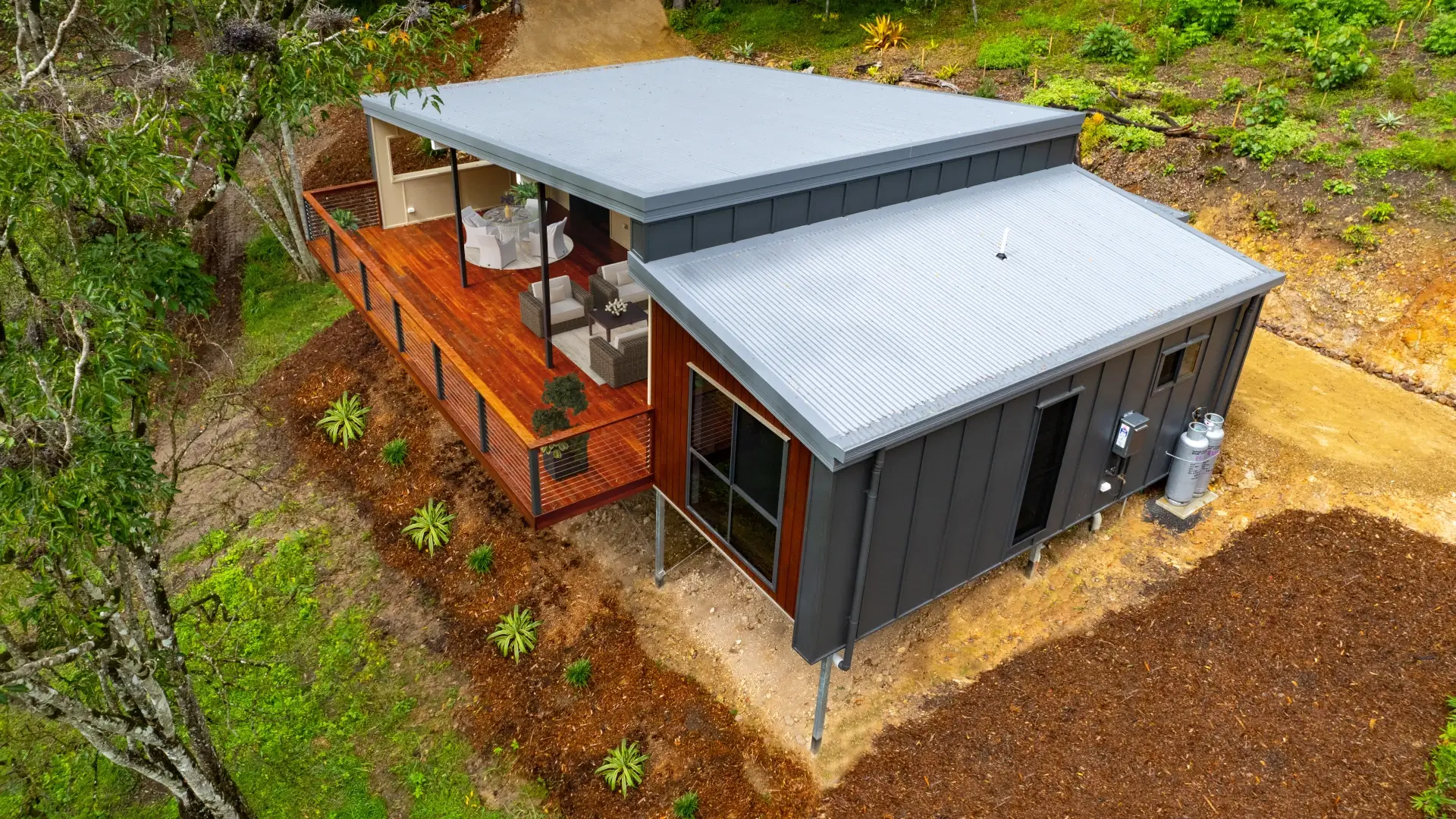
On a 3-metre cross-fall block, for example, the steel floor system accommodates the slope in the structural design — no earthworks, no retaining walls, no cut-and-fill operations. The site stays largely undisturbed, and the natural drainage patterns are preserved. TrueCore engineered steel floor frames are well-suited to this application, combining high strength-to-weight ratio with resistance to the moisture conditions common in Queensland hinterland soils, where ground dampness and reactive clay frequently occur together.
The underfloor space created by a suspended steel floor also adds practical value beyond the structural solution. That space can be enclosed for a garage, carport, or storage area without additional construction above the floor frame. For owners exploring shed home designs suited to sloping hinterland sites, this underfloor flexibility often feeds directly into the design brief.
The steel floor system vs concrete slab sloping block comparison, therefore, is not purely about cost — it is also about how much the site needs to change to accommodate each structural approach.
Cost Comparison: What Drives the Numbers on a Steep Block
Comparing the two systems on material cost alone is misleading. The meaningful comparison includes the full scope of site preparation required to make each system work on steep terrain.
A concrete slab on a steep site includes earthworks, retaining walls, drainage modifications, and potential soil stabilisation costs. On a 3-metre cross-fall block, that combination can add $40,000–$90,000 to the project cost before any wall framing begins — depending on soil classification, site access, and the volume of material to move. An engineered steel floor system on the same site typically adds far less: the engineering, pier footings, and frame costs are generally lower than the equivalent earthworks cost, with no retaining wall construction, no cut material to dispose of, and no site drainage disruption involved.
On a flat or very gently sloping site (under 1m fall), the situation reverses. A conventional slab is cheaper and simpler there. Steel floor systems carry a higher cost per square metre of floor area as a materials item — the advantage only emerges when site preparation is factored into the comparison.
A soil classification test under AS 2870 is required for both systems before the engineer can finalise the footing design. On reactive clay soils — common across the Sunshine Coast and Gympie hinterland, where H1 and H2 classifications are frequent — the footing specification for a concrete slab can increase substantially, adding cost that is often absent from early indicative quotes.
Soil Classification: The Step That Happens Before Either Decision
Before any structural engineer can design a footing system — whether for a concrete slab or a steel floor frame — a soil classification test must be completed. The test classifies the ground under AS 2870, the Australian Standard for residential slabs and footings.
Classifications run from Class A (stable, non-reactive soils) through S (slightly reactive), M (moderately reactive), H1, H2, and up to E (extremely reactive). Reactive clay soils expand and contract with moisture changes. On a concrete slab, that movement can crack the structure and shift footings if the design does not account for the reactivity class. Sunshine Coast and Gympie hinterland soils frequently classify as M or H — reflecting the region's clay-rich geology and high-rainfall environment.
A geotechnical engineer or soil survey firm conducts the classification through bore-hole samples. The resulting report is submitted to the structural engineer before any footing design begins. The process typically takes two to four weeks and costs $500–$1,500, depending on site access and bore depth required.
For owners building in the Gympie hinterland, sloping block builds in the Gympie region frequently encounter H1 and H2 classifications that directly affect footing choice and cost. Understanding this before engaging a structural engineer avoids surprises later in the footing specification process.
Which System Is Right for Your Block?
The right foundation system depends on three site-specific factors: cross-fall gradient, soil classification, and site access for earthworks machinery.
For cross-falls below 1 metre, a stepped concrete slab is often both simpler and more cost-effective — particularly on Class A or S soils where reactive movement is not a significant concern. For cross-falls above 1.5 metres — common across Sunshine Coast hinterland blocks between Maleny, Montville, and the Blackall Range — an engineered steel floor system typically delivers lower total project cost and significantly less site disruption. Sites with highly reactive clay soils (H1 or H2 classification) or restricted access that limits earthworks machinery also favour the steel approach.
As a comparison point, Stroud Homes' pole home approach uses a similar suspended floor logic — timber or concrete poles bridge the slope rather than filling it. However, timber poles carry long-term maintenance requirements and termite exposure risk that steel systems avoid. The trade-off between those systems comes down to upfront cost versus long-term durability and ongoing maintenance.
The Shed House uses engineered steel floor systems specifically designed for sloping and difficult sites on the Sunshine Coast hinterland — the same structural approach used across its residential shed home and kit home builds. For a site-specific recommendation, the sloping block builder on the Sunshine Coast who specialises in steel floor systems can assess your block's cross-fall, soil type, and access conditions before any design commitment is made.
Bring the Slope, Not Just a Budget
Understanding which foundation system suits a sloping block requires a site assessment — cross-fall gradient, soil type, site access, and council setback rules all affect the answer, and the right choice is different for every block.
The Shed House is a sloping block specialist serving the Sunshine Coast, Noosa, and Gympie regions. To book a sloping block site assessment, bring the address, any survey you have, and a description of the slope. That is enough to start a technical conversation about which structural approach suits your specific site — before you commit to a design or a builder.