
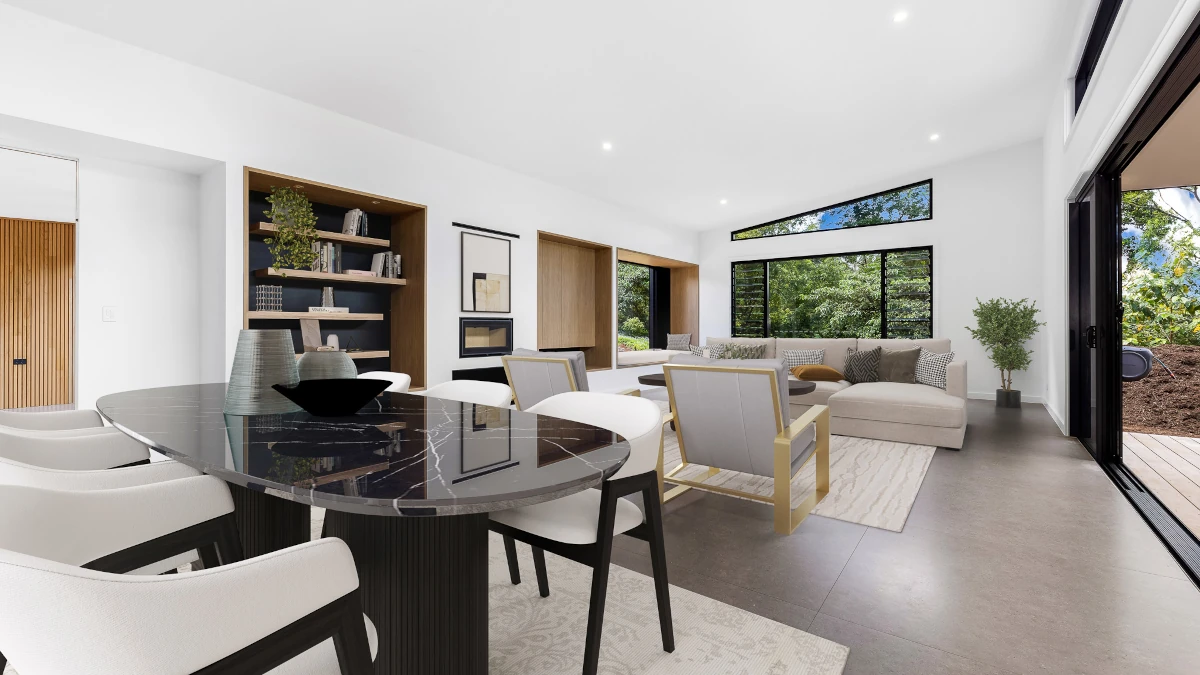
The Sunshine Coast hinterland pulls people in for good reasons. Elevated views, cool mornings, genuine privacy, and the kind of space that coastal suburbs simply cannot offer — rolling acreage where the nearest neighbour is far enough away that you can't hear them. For families and lifestyle buyers relocating from Brisbane or Sydney, hinterland living Sunshine Coast represents a genuine shift in how daily life works.
The appeal is real. However, the hinterland has practical realities that suburban buyers are often unprepared for. Slopes are the norm, not the exception. Town water and sewer don't reach most properties. Zoning rules govern what you can build and where. And the infrastructure gap between two adjacent blocks can represent a cost difference of tens of thousands of dollars before you pour a single footing.
This guide covers what to investigate before committing to a rural block — so you buy the right land for the home you actually want to build.
What "Hinterland" Actually Means in the Sunshine Coast Context
"Hinterland" gets used loosely in real estate listings, but for planning and construction purposes it refers to the elevated rural areas behind the coastal strip. That covers a broad geographic range: the Glass House Mountains foothills to the south, the Blackall Range townships of Maleny, Montville, and Mapleton, the Mary Valley running through Kenilworth and Kin Kin, and the Noosa hinterland extending toward Pomona and Cooroy.
These areas share certain characteristics: basalt and sandstone geology, higher annual rainfall than the coast, and significant topographic relief. Sloping and steep blocks are the norm throughout this region, not the exception. The zoning is also different — rural or rural residential rather than conventional residential — and that distinction shapes everything from what you can build to what infrastructure the council expects you to supply yourself.
Infrastructure access varies considerably across these areas. Some rural residential lots have town water and NBN fibre; others rely entirely on rainwater tanks and satellite internet. Understanding which category a specific block falls into before purchasing is essential. The infrastructure gap between a connected rural residential lot and a fully off-grid rural property represents a significant difference in both upfront cost and day-to-day lifestyle.
Hinterland living Sunshine Coast offers something genuinely different from the coastal strip. For that reason, however, it comes with a specific set of practical conditions that a buyer used to serviced suburban lots will not encounter elsewhere.
Zoning: What Rural and Rural Residential Zones Allow
Rural and Rural Residential zones operate under different development rules compared to standard residential zones — and many buyers are surprised by the restrictions once they have already fallen for a block.
In Rural Residential zones on the Sunshine Coast, a primary dwelling and one secondary dwelling are typically permitted, subject to the council's planning scheme requirements. In Rural zones, development rights may be more limited depending on specific planning scheme provisions and whether an existing dwelling is present on the lot.
The Sunshine Coast Council's planning scheme emphasises maintaining rural character. Buildings must be consistent with the zone's intended amenity, setbacks from roads and boundaries are generally larger than suburban equivalents, and development should avoid dominating the landscape. Deep planted surrounds, low-profile structures, and materials that recede into the environment align with these requirements; stark rendered facades do not.
Noosa Shire has parallel Rural and Rural Residential zone structures with specific provisions around secondary dwellings and water storage for hinterland lots. The zone codes differ between councils, so a property that sits just inside the Noosa Shire boundary operates under different rules than one in the Sunshine Coast Council area.
Before engaging a designer or builder, check the specific zone of any potential purchase through the relevant council's interactive mapping tool, then read what the applicable zone code permits. This step takes an hour and can prevent a very costly mistake.
Water Storage: The Requirement Most Buyers Miss
On rural and rural residential blocks without town water connection, supply comes from rainwater tanks fed by roof catchment, dams, or bores. This is standard practice on most Sunshine Coast and Noosa hinterland properties, and most buyers expect it. What buyers frequently do not realise until after purchase is that local planning schemes mandate minimum water storage volumes — and the numbers are larger than most people assume.
Under Part 9 of the Noosa Plan 2020, rural properties without reticulated town water must provide a minimum of 60,000 litres of water storage where the dwelling has more than three bedrooms or includes a secondary dwelling. That requirement can be met through rainwater tanks, underground concrete tanks, or a combination — but a single standard 25,000L poly tank does not meet it on its own. Most hinterland properties need two or three large tanks, or an underground system, to comply.
The cost of meeting the water storage requirement ranges roughly from $5,000 to $20,000 depending on tank type, installation complexity, and site access. On steep blocks with difficult vehicle access, installation costs rise further. Therefore, this figure should be factored into the land purchase budget before exchange — not discovered partway through the building approval process.
When evaluating any hinterland block without town water, confirm whether the property already has compliant storage in place. If not, budget for it as a non-negotiable part of the build cost.
![image placeholder]
Sloping Blocks: The Hinterland Reality and What It Means for Your Build
Most hinterland blocks slope. Many slope significantly. Cross-falls of three to six metres across a house footprint are common through the Blackall Range and Noosa hinterland — sites where a standard flat-land design simply will not work without reshaping the ground.
For buyers coming from suburban lots, the sloping block requires a fundamentally different structural approach. A concrete slab on cut-and-fill earthworks can handle a gentle gradient, but on anything steeper than a one-metre cross-fall it becomes expensive, disruptive, and problematic for stormwater management. An engineered steel floor system, by contrast, spans the slope from beneath — supporting the floor platform without cutting into the hillside or importing large volumes of fill material.
The Shed House uses engineered steel floor systems specifically designed for sloping and difficult hinterland sites. For sloping block construction options for hinterland sites, the steel floor approach preserves the natural ground beneath the house, reduces earthworks costs, and produces a more stable result on challenging terrain. Working with sloping block specialists on the Sunshine Coast hinterland means the structural solution is built into the design from the start rather than retrofitted after the problem is discovered on site.
The slope gradient also affects what floor plan configurations are practical. Houses designed for flat suburban blocks often need reconfiguring for a steep site — not just structurally, but in terms of how internal spaces connect and flow. Therefore, have a building professional walk any potential purchase before exchange. The goal is to confirm whether the intended home design is achievable on that specific site without prohibitive earthworks costs.
Home Design for Hinterland Living: What Works and What Doesn't
A home that performs well in the hinterland looks and functions differently from a suburban house. The design characteristics that work best on Sunshine Coast rural sites share common elements: orientation that captures prevailing breezes and frames the rural view; large covered verandahs or decks that extend the living space into the landscape; materials that are durable in a high-rainfall, humid, and potentially bushfire-prone environment; and ceiling heights that promote airflow and suit the scale of the rural setting.
The Ilkley Range — hinterland lifestyle home designs for rural Sunshine Coast blocks is designed around exactly these principles. The range features raked ceilings and indoor-outdoor configurations suited to hinterland living, along with Weathertex eco-timber cladding — available in Selflok and Primelok profiles — that blends with the bush setting while requiring minimal ongoing maintenance.
On sloping sites, the elevated steel floor frame creates practical under-house space that flat-site designs cannot offer: storage, a carport, or a garage integrated into the lower level naturally rather than added as an afterthought. This changes the floor plan possibilities for steep blocks considerably.
Cladding colour also matters more in the hinterland than in suburban settings. Darker Colorbond tones such as Monument and Basalt are popular because they recede into the bush rather than dominating the landscape. Weathertex timber cladding offers a more organic connection to the surrounding environment for buyers who want the home to sit lightly on the land. For buyers also exploring family home designs suited to rural and acreage living, these design principles apply across a range of floor plan sizes and configurations.
Waste Management, Power, and Other Infrastructure to Investigate
Water storage is the most commonly overlooked infrastructure issue, but it is not the only one. Four additional questions should be answered before committing to a hinterland block.
Wastewater. Rural properties without town sewer require an on-site wastewater system — septic, aerobic treatment unit, or equivalent — that must be approved by council and engineered for the site's soil type. Approval runs alongside the building approval process and can be time-consuming on complex sites. Many Sunshine Coast hinterland properties have soil types that require a specific effluent dispersal design rather than a standard septic field.
Power. Mains electricity reaches most Sunshine Coast and Noosa hinterland properties; however, connection costs vary depending on the distance from the nearest transformer. Off-grid solar and battery systems are increasingly viable but require a larger upfront investment and careful sizing to support a full-time residential load.
Internet. NBN coverage varies significantly across the hinterland by specific address. Starlink satellite broadband is widely used as either a primary or backup connection where NBN signal is poor. For remote workers, this detail is non-negotiable — check the address on the NBN rollout map before purchasing land.
Road access and driveway. The condition and legal status of access tracks on large rural blocks affects construction logistics during the build — machinery and materials access — and the ongoing maintenance burden after completion. A steep, unsealed access track adds real cost and complexity to both phases.
![image placeholder]
Get a Site Assessment Before You Sign
The best time to involve a builder in a hinterland land search is before exchanging contracts — not after. A single site visit from a building professional can assess slope, soil type, machinery access, and infrastructure gaps, and gives you a realistic picture of what the land will actually cost to build on.
For buyers actively looking at rural Sunshine Coast or Noosa hinterland properties, send an enquiry about your hinterland block or property search to discuss a pre-purchase site assessment. It is a practical due diligence step — the kind that changes what a block is genuinely worth to you before you commit to buying it.