

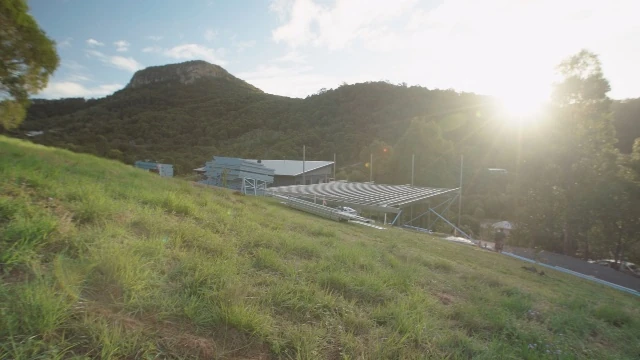
Sloping blocks are extremely common across Queensland's hinterland. Much of the Sunshine Coast and Gympie region sits on basalt and sandstone geology, where a cross-fall of two to five metres across a typical house footprint is completely standard. Building on a sloping block in Queensland isn't the exception — for many hinterland buyers, it is the planning reality they need to work with from day one.
The challenge isn't whether you can build on a slope. The challenge is understanding which structural approach suits your specific site before the engineer starts designing. Different methods — cut-and-fill, pole construction, or an engineered steel floor frame — handle slope in fundamentally different ways. Choosing the right one early avoids costly redesign later.
This guide explains the engineered steel floor system step by step: from the initial soil test through to the completed frame, so anyone considering building on a sloping block in Queensland knows exactly what the process involves.
Step One: The Soil Classification Test
Before any structural engineer can design a footing system for a sloping block, a geotechnical engineer must conduct a soil classification test. The test classifies the soil under Australian Standard AS 2870, assigning the site a class from A (stable, non-reactive) through S, M, H1, H2, and up to E (extremely reactive). This range covers the full spectrum from stable granular soils to highly reactive clays that expand and contract significantly with seasonal moisture changes.
Sunshine Coast and Gympie hinterland soils are frequently classified as M or H due to the region's clay-rich geology and high annual rainfall. These soils move considerably between wet and dry seasons — a movement cycle that must be accounted for in the footing design. The soil classification directly determines the footing depth, footing width, and the amount of reinforcement required in the concrete footings that will anchor the steel floor system.
Getting this test done before design starts — rather than after — prevents costly redesign when site conditions turn out to be more reactive than assumed. The test typically involves bore-hole samples at several points across the building footprint. For anyone exploring sloping block solutions across Queensland, this test is the non-negotiable first step regardless of which construction method is eventually chosen.
Step Two: Site Survey and Contour Mapping
Alongside the soil classification, a licensed surveyor produces a contour map of the block — a precise record of the ground elevation across the building footprint and surrounds. For a sloping block, this map is essential for the structural engineer to calculate the height difference the steel floor frame must bridge at each point.
A cross-fall of 2.5 metres means the steel posts on the low side of the building will be significantly taller than those on the high side. The survey also identifies embankments, drainage lines, and existing trees that affect footing placement. Surveyors access the site with total station or GPS equipment; the resulting data is provided to the engineer in digital format.
On irregular or heavily vegetated terrain, survey costs increase due to access difficulty. However, the investment is worthwhile — changes to the floor frame layout discovered after engineering design begins cost considerably more to resolve than the survey itself. The contour map and soil classification together are the two inputs the structural engineer needs before any floor frame design can begin. On the Sunshine Coast hinterland, expect surveying to cost in the $800–$2,000 range for a standard residential footprint, varying with site access and complexity.
Step Three: How the Engineered Steel Floor Frame Is Designed
Armed with the soil classification and contour data, the structural engineer designs a steel floor frame that achieves a level finished floor platform regardless of the slope beneath it. The design specifies the number, position, and depth of concrete footings; the size and gauge of steel posts at each footing point; the size and connection details of the horizontal steel bearers and joists that form the floor platform; and the bracing required to resist lateral loads from wind and seismic activity.
TrueCore engineered steel floor frames are engineered to Australian structural standards and arrive on-site as a pre-cut, pre-drilled kit — reducing on-site cutting and fit-up time significantly. Each piece is labelled to match the engineer's drawing, so the erection sequence is precise. The engineer's documentation forms part of the building approval package submitted to the building certifier before physical construction begins.
On steep sites, the engineer may also specify tie-down connections at the top of the steel posts to prevent uplift under wind loading — a common requirement on elevated, exposed hinterland blocks. This detail is site-specific and only appears in the structural drawings once the contour and soil data have been assessed.
Step Four: Concrete Footings and Steel Post Installation
With the engineering documentation approved, the physical build begins. The first stage is excavating and pouring concrete footings to the depth and diameter the engineer has specified. On a sloping block, footing depths vary across the footprint — the load-bearing stratum may be at different depths on the high and low sides of the block, so each footing is designed to its own specification rather than applied uniformly.
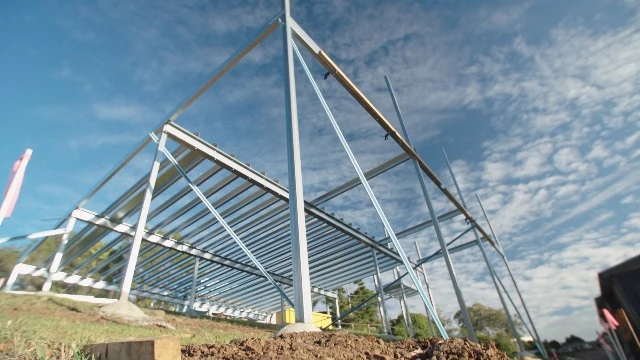
Once the footings have cured, steel posts are set into them using bolt-down baseplates or cast-in-place bolt systems as specified in the engineering drawings. The posts must be set plumb — perfectly vertical — using a surveyor's level. On a sloping site, this precision is critical: the finished floor frame relies on all posts sitting at exactly the correct height.
Bearer steels then connect across the tops of the posts, spanning the slope at the designed finished floor height. The visual effect at this stage is striking: the posts on the low side of the slope are visibly taller than those on the high side, demonstrating clearly how the frame bridges the slope rather than fighting it. This stepped appearance is temporary — once the floor platform is in place, the internal level is consistent across the entire building footprint.
Step Five: Floor Joists, Flooring, and the Finished Platform
With the bearer steels in place, floor joists are installed at right angles across the bearers at the spacing specified in the engineering drawings — typically 450mm or 600mm centres depending on floor load and span. TrueCore steel joists are pre-cut to length and connect to the bearers using engineered joist hangers. Once the joist grid is complete and the required bracing is installed, the floor decking is laid — typically 19mm or 22mm structural plywood, or fibre cement sheet in fire-affected zones.
The result is a rigid, level floor platform sitting above the slope with the same structural integrity as a flat-slab foundation system. Buyers can explore shed home designs suited to sloping hinterland sites to understand how the completed platform supports the floor plans and interior volumes that are possible on steep terrain. The design options on an elevated platform are broader than most buyers expect.
The space beneath the floor frame — which on a steep block can be several metres of clearance on the low side — is practical, usable space. Enclosing this area creates underfloor storage, a carport, or a garage as part of the original build, adding meaningful floor area at minimal extra structural cost.
How This Approach Differs from Pole Homes and Concrete Slabs
Pole homes — common in the Sunshine Coast and Noosa area — use the same suspended floor logic as a steel floor system, but with timber or concrete poles as the supporting elements. Stroud Homes' pole home approach represents the most established alternative in the local market, using timber poles designed for the region's sloping coastal terrain. However, timber poles require ongoing maintenance and termite treatment in Queensland's subtropical climate. Concrete poles are more durable but heavier, requiring larger excavations.
A TrueCore steel floor system avoids both concerns. The steel is termite-proof and requires no ongoing treatment. Furthermore, compared to a cut-and-fill concrete slab, the steel floor system preserves the natural drainage of the site, avoids the need for retaining walls on the cut side, and typically causes less site disruption during construction.
The practical trade-off is that a suspended steel floor has slightly more flex underfoot than a poured concrete slab — an audible difference in hardwood or tile floors when walking. This is worth considering during the flooring specification stage rather than discovering after installation.
For buyers comparing options with sloping block specialists on the Sunshine Coast or investigating sloping block builds in the Gympie region, a site assessment will confirm which structural approach best suits the specific cross-fall, soil type, and intended design.
Every Sloping Block Is Different — Start With a Site Assessment
The soil type, cross-fall gradient, and council zone on your block all affect the engineering approach and the eventual build cost. A general guide explains the process; a site-specific assessment tells you what applies to your land. Those are two different things.
The Shed House uses engineered steel floor systems specifically designed for sloping and difficult sites on the Sunshine Coast hinterland. As a sloping block specialist serving the Sunshine Coast, Noosa, and Gympie regions, the starting point is always a proper assessment of the site before any design or cost commitment.
To get a real answer for your block, arrange a sloping block assessment through our enquiry form — bring the address, any existing site survey, and the soil report if you have one already.